Mild Steel vs Stainless Steel Gates: Which Material for Your Nottinghamshire Home?
Mild steel vs stainless steel gates explained by Jayded Metalworks. Honest trade-offs, finishes and local advice for Nottinghamshire, Derbyshire and Birmingham.
Mild Steel vs Stainless Steel Gates: What Actually Makes the Difference
Choosing between mild steel and stainless steel for a new gate is one of the most common conversations we have with homeowners across Nottinghamshire, Derbyshire and Birmingham. Both materials are strong. Both can be fabricated into almost any design you can sketch on a piece of paper. But they behave differently over time, they suit different settings, and they involve different decisions around finishing and maintenance.
This is our honest take, from the workshop, on what each material actually means for a gate you are going to live with for decades.
What Is the Main Difference Between Mild Steel and Stainless Steel?
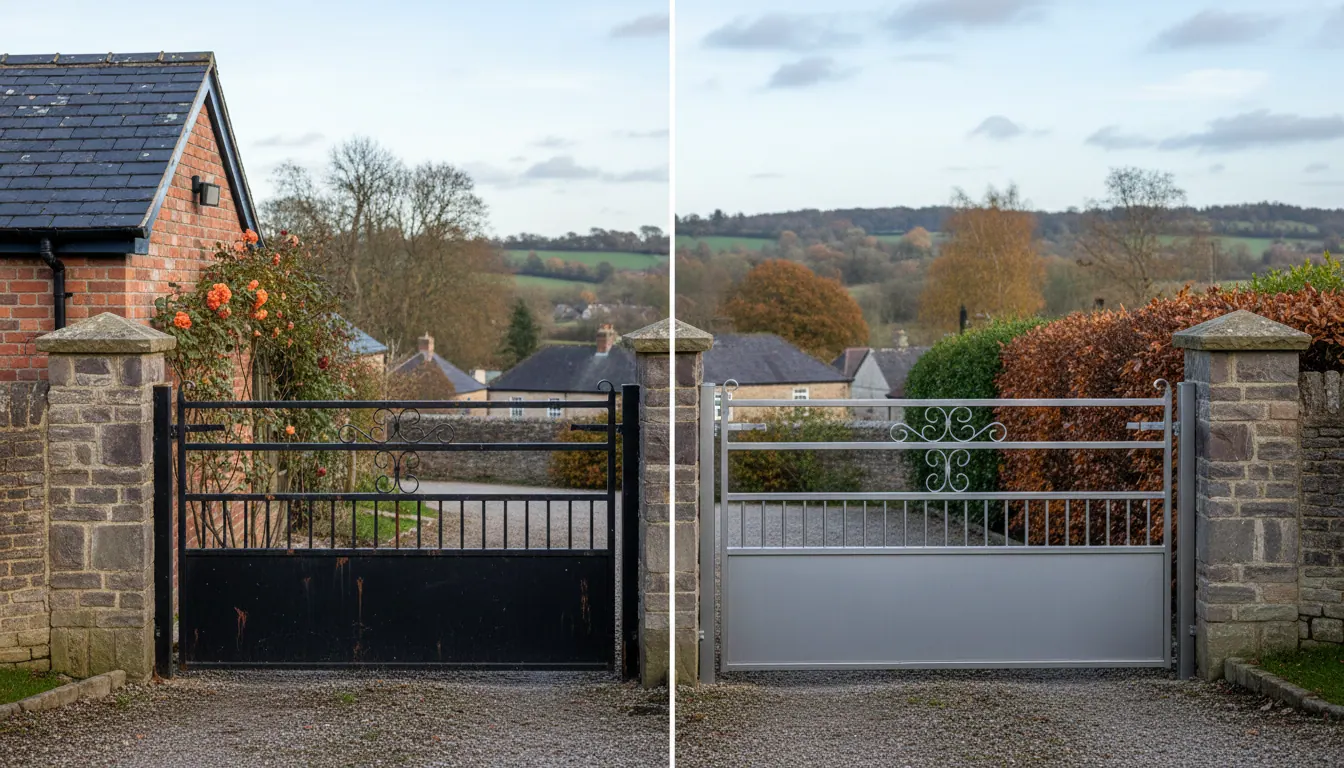
Mild steel is iron alloyed with a small amount of carbon. It is the most widely used structural metal in fabrication. It welds cleanly, it bends and cuts predictably, and it takes decorative work beautifully. Left bare and exposed to rain, it will rust. That is not a flaw exactly, it is just the nature of the material, and it is entirely manageable with the right surface treatment.
Stainless steel contains chromium, typically around 10 per cent or more. That chromium content creates a passive oxide layer on the surface that resists corrosion without any additional coating. The name is a slight exaggeration (it can still mark or stain in the wrong conditions) but in practical terms, a well-specified stainless gate will hold its finish for a very long time with minimal intervention.
The key trade-offs:
- Mild steel is easier to shape, easier to weld into complex decorative forms, and generally more forgiving to work with. It needs a protective finish, whether that is paint, powder coat or hot-dip galvanising.
- Stainless steel costs more as a raw material, is harder to weld neatly (TIG welding is usually the right process), and requires more care in fabrication. The payoff is a finish that does not rely on a coating to resist corrosion.
We work in both materials every week, using MIG and TIG welding in-house, so the choice genuinely depends on your situation rather than on what is easiest for us to produce.
When Mild Steel Makes More Sense for Gates
For most residential driveway gates across Nottingham, Derby, Long Eaton, Beeston, Ilkeston, Mansfield and Chesterfield, mild steel is the default choice. Here is why.
Mild steel gives us the most design freedom. Scrollwork, flat bar panels, infill patterns, decorative collars, curved tops, all of these are easier to achieve cleanly in mild steel. If you have come to us with a sketch or a photo of something you want, mild steel is almost always the material that lets us get closest to it.
Powder coating provides a tough, long-lasting finish. A good powder coat, applied over a properly prepared and primed surface, protects mild steel gates for many years. We discuss colour, gloss level and finish texture with every customer. Anthracite grey is popular at the moment, but we have produced gates in every RAL colour you can think of.
Hot-dip galvanising is the heavier-duty option. It bonds zinc to the steel at a molecular level, giving a sacrificial layer that continues to protect even if the surface is scratched. For exposed rural locations around Derbyshire or for agricultural settings on the edge of the area, galvanising before powder coating gives extra peace of mind.
The honest caveat: mild steel gates need checking periodically. If the coating is damaged and left, moisture gets in and rust follows. That is not a disaster, it is a maintenance job, but it is worth knowing before you commit.
See our article on bespoke metal gates for Derby and Nottinghamshire for more on the design process, including how we work from your own sketch or photo.
When Stainless Steel Is Worth the Extra Investment
Stainless steel comes into its own in specific situations. It is not always the right answer, but when it is, it is very much the right answer.
Coastal or high-moisture environments. Parts of the West Midlands and urban Nottingham have microclimates that are hard on coatings. If a gate faces prevailing weather with no shelter, stainless holds up better over time.
Contemporary or minimalist design briefs. Stainless steel suits clean lines and brushed or polished finishes. For a modern house in Birmingham or a new-build in Long Eaton where the brief is sharp geometry and low visual noise, stainless delivers a look that mild steel with a paint finish cannot quite replicate.
Low-maintenance is genuinely important to you. If you want to install a gate and largely forget about it, stainless is the more hands-off option. There is no coating to chip, no primer to maintain, no rust to catch early.
Posts and hardware in contact with concrete. Even on a mild steel gate, we sometimes specify stainless fixings, posts or ground anchors where they will be embedded or in contact with moisture-holding materials. The gate might be mild steel, but the buried metalwork is stainless.
One thing worth saying plainly: stainless steel does not last forever simply by existing. The grade matters. Marine-grade stainless (316) performs better in harsh conditions than the more common 304 grade. We specify the right grade for the job rather than defaulting to the cheapest option.
Gate Design: Does the Material Change What Is Possible?
Broadly, yes. Mild steel is more malleable and lends itself to traditional or ornate gate designs: vertical bar gates with decorative tops, framed panel gates with timber or composite infills, and anything with curved or scrolled detailing. If you want a gate that references period ironwork in Chesterfield or Mansfield, mild steel is almost certainly the better fit.
Stainless steel works best in clean, geometric forms. Horizontal bar designs, frameless panel gates, and gates with glass or powder-coated aluminium infills all suit stainless well. It is the material of choice when the gate needs to look like it belongs to the building rather than sitting in front of it.
We also make composite infill gates, where a mild or stainless steel frame holds timber or composite board panels. That combination gives you the structural integrity of a metal frame with the warmth of a timber finish. Worth considering if you want privacy alongside a more traditional look.
For more on material options and how they work for driveway gates specifically, our article on driveway gates in Long Eaton and Beeston covers mild steel, stainless and aluminium side by side.
What About Aluminium? A Brief Word
Aluminium comes up in this conversation too. It is lighter than both steel options, it does not rust, and it suits powder-coated finishes well. For gates where weight matters (automated gates especially, or gates on longer spans), aluminium is worth considering. It is not quite as strong as steel for the same section size, so the fabrication details differ, but it is a genuine option rather than a compromise.
We fabricate in all three materials and will tell you honestly which suits your project best.
Frequently Asked Questions
What is the main difference between mild steel and stainless steel gates?
Mild steel is strong and versatile but needs a protective finish (paint, powder coat or galvanising) to prevent rust. Stainless steel contains chromium, which gives it natural corrosion resistance without a coating. Mild steel allows more complex decorative work; stainless suits contemporary, low-maintenance designs. Both are fabricated and welded in our workshop, and both can last for decades when specified and maintained correctly.
Which is better for a home gate: steel or wrought iron?
Wrought iron is largely a historical material. Most gates described as "wrought iron" today are actually mild steel, fabricated to look like traditional ironwork. True wrought iron is rarely produced or used in new fabrication. When customers ask for wrought iron gates in Chesterfield, Mansfield or Nottingham, what they usually want is the style, and mild steel delivers exactly that. We restore genuine older ironwork too, but for new gates, mild steel is the practical choice for that traditional look.
Can stainless steel gates really last a very long time without maintenance?
Stainless steel is genuinely durable. The chromium oxide layer reforms when scratched, which is why it holds up so well. That said, the grade of stainless matters, and in very aggressive environments (road salt, industrial pollution, coastal air) even stainless can mark or pit over time. Marine-grade 316 stainless performs better in those conditions than standard 304. No metal is entirely maintenance-free; stainless just requires far less attention than coated mild steel.
Do I need planning permission for new gates in Nottinghamshire or Derbyshire?
For most domestic driveway gates under two metres, permitted development rules typically apply and planning permission is not required. However, if your property is in a conservation area, a listed building or subject to a planning condition, the rules are different. Always check with your local planning authority before installation. We can advise based on what we know from working across the region, but the formal confirmation needs to come from your council.
Ready to Talk Through Your Gate Project?
If you have a design in mind, a photo of something you like, or simply a gap in your driveway that needs filling properly, we are happy to come out and measure up. We cover Nottingham, Derby, Beeston, Long Eaton, Ilkeston, Mansfield, Chesterfield and Birmingham, and we quote each job individually once we understand exactly what is needed.
Call us on 07309 647461 to get the conversation started. Monday to Saturday, from the workshop.