MIG vs TIG Welding: Which Process for Your Custom Metalwork?
MIG and TIG welding explained by a hands-on fabricator serving Nottingham, Derby, Birmingham and across the Midlands. Find out which process suits your job.
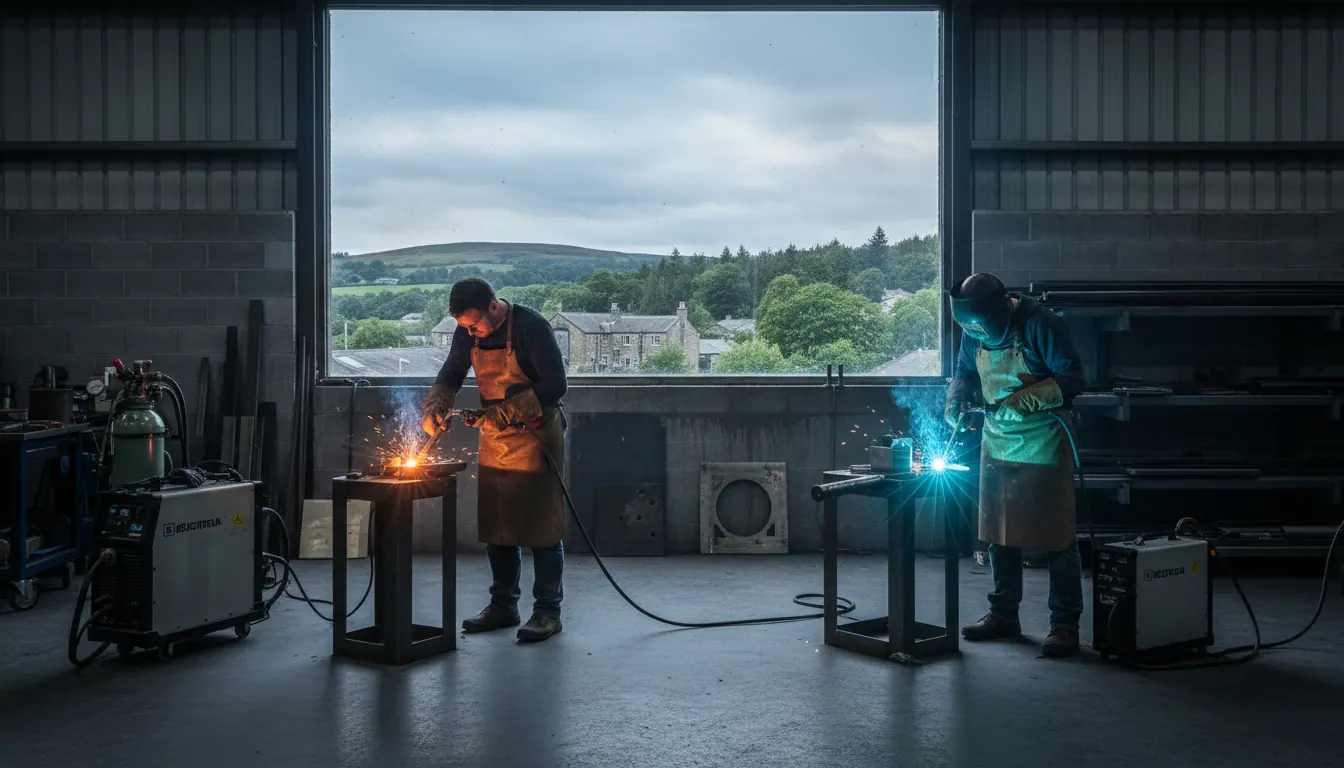
Two processes, one workshop, and why the difference actually matters
Steel is steel until you weld it. Then the process you choose shapes everything: the strength of the joint, the finish on the surface, the time it takes and the material it suits. We use both MIG and TIG welding here at Jayded Metalworks, and we pick the right one for each job rather than defaulting to whichever is quicker. If you are a homeowner in Nottingham planning new driveway gates, a builder in Birmingham needing bespoke brackets, or a landlord in Chesterfield chasing a railing repair before the weather turns, understanding the basic difference helps you have a better conversation with us from the start.
So here is a plain-English explanation of both processes, when we reach for each one, and what that means for your finished piece.
What MIG welding actually is
MIG stands for Metal Inert Gas. A continuous wire electrode feeds automatically through the welding torch, melts into the joint and fuses the parent metal together. An inert shielding gas (usually argon or a mix of argon and CO2) flows around the arc to protect the weld pool from atmospheric contamination.
The key word is continuous. Because the wire feeds itself, a skilled MIG welder can lay down a run quickly and consistently. That makes MIG the go-to process when:
- You are working with mild steel sections, box section or flat bar
- The joint is long and needs to be run in one pass
- Speed matters without sacrificing structural integrity
- The finished weld will be ground, primed and powder-coated anyway
Most of our gate and railing work is MIG welded. A set of driveway gates for a property in Long Eaton or Beeston involves dozens of joints, and MIG lets us build the frame accurately and efficiently while still producing welds strong enough to carry the weight of the gate and handle daily use. If you want to read more about the kind of work that comes out of the MIG side of the workshop, our article on sheet metal fabrication for gates and railings covers the process in more detail.
What TIG welding actually is
TIG stands for Tungsten Inert Gas. Instead of a consumable wire feeding automatically, the welder holds a non-consumable tungsten electrode in one hand and feeds filler rod manually with the other. The arc is finer, the heat input is more controlled, and the result is a much cleaner, narrower weld bead.
That control comes at a cost: TIG is slower and demands more skill. But for certain jobs, nothing else comes close. We use TIG when:
- The material is stainless steel or aluminium
- The finished weld will be visible and needs to look polished
- The section is thin and needs precise heat management to avoid warping
- The joint geometry is complex or the access is tight
Stainless steel handrails for a period cottage in Mansfield or a shopfront in Derby are a classic TIG job. The weld needs to be clean enough to brush or polish alongside the parent metal. A MIG bead on stainless, even a good one, leaves too much oxidation and too rough a profile to finish neatly. TIG gives us the control to make a handrail look as though it grew that way. You can see the kind of finished results we aim for in our article on stainless steel handrails and balustrades.
Is one stronger than the other?
This question comes up a lot, and the honest answer is: not in any meaningful way for the work we do. Both processes, done properly, produce welds that are at least as strong as the parent metal. The joint will not fail at the weld if the preparation is right and the technique is sound.
Where TIG has an edge is in precision. The narrower heat-affected zone means less distortion in thin material, and the cleaner bead means less porosity risk. For structural balustrade posts or gate hinges carrying real load, that precision matters. But a well-executed MIG weld on properly prepared mild steel is not going to let you down.
What makes welds fail is poor preparation, wrong wire or filler for the material, or rushing. Not the choice of process.
MIG, TIG and MMA: what about stick welding?
MMA (Manual Metal Arc, also called stick welding) is the third process people often ask about. It uses a flux-coated consumable electrode and needs no shielding gas, which makes it useful outdoors or in conditions where gas coverage is hard to maintain. We do not use MMA as our primary process for fabrication work, but it is worth knowing the distinction:
- MIG: fast, consistent, best for mild steel fabrication in a workshop setting
- TIG: slow, precise, best for stainless steel, aluminium and visible joints
- MMA: robust, portable, useful for site repairs and heavier structural work
For the one-off bespoke fabrication we specialise in, MIG and TIG cover the vast majority of what we make. Gates, railings, Juliette balconies, custom steel furniture, brackets, frames and guards all come out of the MIG or TIG side of the workshop depending on material and finish requirements.
How we choose in practice
When a customer in Ilkeston asks us to fabricate a set of mild steel estate gates, the frame goes together on MIG. Flat bar scrolls and decorative details, also MIG. Prime, paint or powder coat, done.
When a customer in Derby wants a stainless handrail running up the side of a Victorian terrace, every joint is TIG welded, dressed back and polished. The finish has to match the material, and MIG simply cannot get there on stainless.
When a builder in Birmingham sends us drawings for a series of machine guards in mild steel with a painted finish, MIG again. Speed and repeatability matter, the finish will be hidden under paint, and MIG delivers both.
When a homeowner in Nottingham wants a bespoke steel and glass Juliette balcony where the frame will be on show, we assess the material choice first. Mild steel frame, MIG welded and powder-coated. Stainless frame, TIG welded and brushed. The process follows the material and the finish requirement, not the other way around.
What this means for your project
You do not need to specify which welding process you want. That is our job. What helps us is knowing:
- What material you have in mind (or whether you want our recommendation)
- Whether the welds will be visible in the finished piece
- What the piece needs to do and what loads it will carry
- Where it is going and what the environment is like (outdoors, coastal, commercial kitchen, etc.)
From there, we make the right call. If you are anywhere across Nottinghamshire, Derbyshire or the West Midlands and want to talk through a project, we are straightforward about what works and what does not. We also travel to measure up and meet clients on site, so if you are in Chesterfield, Mansfield, Long Eaton or Birmingham, we can come to you.
Frequently asked questions
What are the main applications of MIG welding? MIG welding is used across a huge range of fabrication work: structural frames, gates, railings, brackets, machine guards, steel furniture and general repairs. In our workshop it is the primary process for mild steel fabrication. It suits long runs, thicker sections and jobs where the weld will be finished with paint or powder coat. For homeowners across Nottinghamshire and Derbyshire, most gate and railing projects come together with MIG.
Is TIG or MIG welding stronger? Both processes produce welds that are at least as strong as the surrounding metal when done correctly. TIG gives finer control and a narrower heat-affected zone, which matters for thin material and precision joints. MIG, done well on properly prepared mild steel, is equally reliable for structural work. The strength of a weld depends far more on preparation and technique than on the choice of process.
What is the difference between MIG, TIG and MMA welding? MIG uses a continuously fed wire electrode with shielding gas, making it fast and consistent for workshop fabrication. TIG uses a tungsten electrode and manual filler rod, giving finer control for stainless steel, aluminium and visible joints. MMA (stick welding) uses a flux-coated rod and needs no gas, making it more portable for site repairs. We use MIG and TIG in-house, choosing between them based on the material and the finish required.
Do I need to know which welding process I want before contacting you? Not at all. When you get in touch, we ask about the material, the finish and what the piece needs to do. We make the process decision based on those answers. What helps most is a sketch, a photo or a clear description of what you have in mind. We design from your brief and fabricate by hand, so the technical choices happen at our end.
Ready to talk through a project? Call us on 07309 647461 and we will work out the right approach for your material, your finish and your site. We are open Monday to Saturday and happy to come out and measure up anywhere across Nottinghamshire, Derbyshire, Birmingham and the West Midlands.